Give each workload its space
Assign GPUs to desktops, models and containers. Independent workloads load in parallel; a failure in one does not discard the others.
 Xur
XurA gaming desktop. A local model. Or both at once. Xur gives your GPUs a job, with profiles you control from a browser.
An image-based OS for GPU workload profiles, built on Bazzite.
Two desktops and a language model, each with its own GPUs.
A profile describes which workloads to run and where they belong. Save a few for the way you use your machine, then switch from the control panel.
Assign GPUs to desktops, models and containers. Independent workloads load in parallel; a failure in one does not discard the others.
Reuse a named workstation across profiles to keep its user and Moonlight pairing. Assign USB devices or a hub, and choose a primary desktop for shared peripherals.
Find ready language-model endpoints in one place. Try a conversation or retain a benchmark with the model, running workloads and sampled VRAM.
These example layouts use four RTX 3090s. Your profiles depend on the GPUs, memory and models you have.
Set up a workstation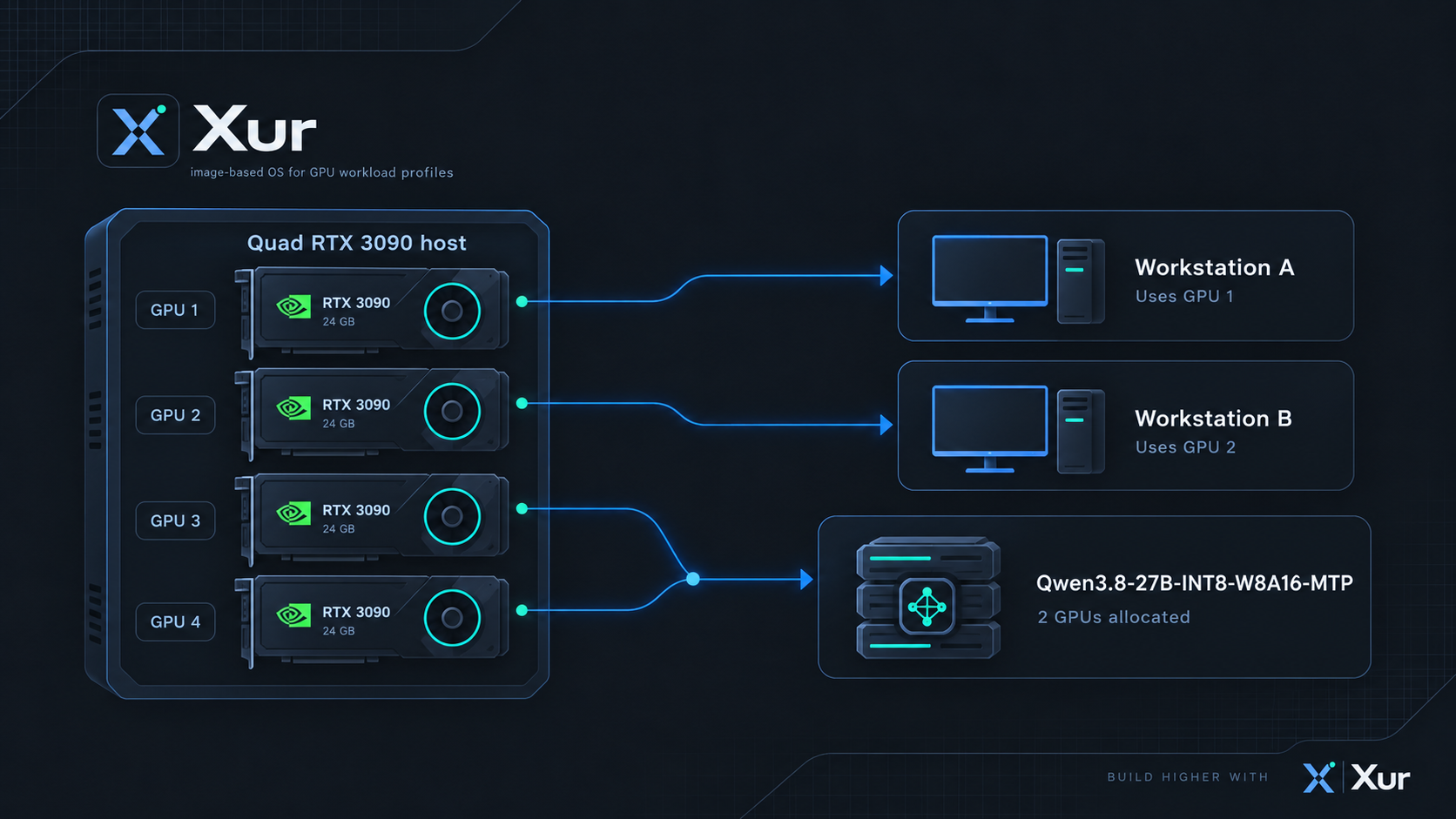
Xur is preparing for its first release. Follow development, inspect the code and report what works on your hardware. Release downloads and their notes live on GitHub.
View releases